3) A plan that exempts from future Medicare cuts anyone born before 1957 -- about a quarter of the population, which includes me -- is neither brave nor serious. See "canny or cynical: take your pick" above.This may not be brave, but is definitely serious. Old people are numerous and prone to voting. They also have a choice. If you are in your mid-fifties or older today there is a reasonable chance that you will be dead before the country's fiscal situation implodes. It therefore makes sense to veto any proposal that reduces benefits. There are plenty of voters under the age of 54, but they are in a very different situation. Barring untimely demise, these Americans will live to see the nations fiscal Waterloo. They therefore have an incentive to accept painful reforms in order to avert the otherwise inevitable disaster. The political reality is that no reform that adversely impacts current AARP members has any chance of adoption. It is neither brave nor serious to ignore that fact.
Sunday, April 10, 2011
Unfortunately Serious
James Fallows of the Atlantic has given seven reasons that Paul Ryan's budget proposal is neither brave nor serious. I'll grant that 6 out of 7 are pretty solid. The exception is:
Sphere: Related Content


Sunday, January 16, 2011
Right Price?
I'm not sure exactly how they do it, but Goldman Sachs has an incredible ability to receive credit for being smarter than they probably are. Consider this from the Wall Street Journal's Opinion page (gated):
Sphere: Related Content
In fact, the firm's real talent isn't knowing what the price will be, but what the price is. And Goldman clearly hit the mark with the $50 billion valuation implied by its $450 million investment in Facebook last week. The firm also rigged up a deal to make $1.5 billion in Facebook shares indirectly available to its well-heeled clients, and every sign is that the offer was oversubscribed.If the offer was oversubscribed then Goldman clearly did not "hit the mark". Having more willing buyers than shares to sell means the price was set to low and Goldman left money on the table - to the detriment of their clients, the existing shareholders of Facebook.
Thursday, December 9, 2010
How can supposedly professional politicians be so shockingly bad at politics?
House Democrats have decided to make a great show of refusing to support the President's deal on extending the Bush tax cuts. It is difficult to understand why any remotely competent politician would take on such a clearly untenable position. The inevitable climb down is clearly going to be deeply humiliating. At the present time Democrats currently have two plausible alternatives:
Sphere: Related Content
- Pass, however grudgingly, the President's tax deal
- Dig their heals in and ensure that:
- The President is severely damaged (What use is a President who can't even rally his own party?)
- Democrats take the blame for everyone's taxes going (Can't avoid that when you willfully torpedo a bipartisan deal)
- The replacement deal to extend the Bush tax cuts will be done by the next Congress, in which Democrats will have even less leverage (Because that's what happens when you lose the house)
Sunday, December 5, 2010
Tuesday, November 30, 2010
A Dose of Reality for Fiscal Conservatives
It appears that Messers. Erskine and Bowles are having some difficulty rounding up support from either Republicans or Democrats for their deficit reduction proposal. This was entirely predictable, but very disheartening for those of us who would like to see the deficit reduced mainly through expenditure control. What Republicans have apparently failed to grasp is that time is not on the side of fiscal conservatives. As this insightful article points out, the longer we wait the more inevitable tax increases become:
Sphere: Related Content
To understand the stakes facing fiscal conservatives, one must appreciate how demographics, program indexing methods and political realities combine to stack the deck against them. By bipartisan consensus, we won't cut the benefits of those already in retirement; we won't send a $2000 check to an 85-year-old widow in January and then cut it back to $1600 in February. Both parties (including the most conservative members) repeatedly reaffirm their dedication to this principle. As a result, with each new class of retirees there is a new set of politically inviolate benefit obligations. Moreover, due to the wage-indexation of the initial benefit formula, the minimum threshold of politically acceptable future benefits rises with each subsequent class of retirees. So, with each year of delay the share of the problem eventually solved by tax increases inevitably rises.* Well before 2037, unless we cut benefits for those already retired, a tax increase could not be avoided even if the entirety of payments to new beneficiaries were shut off. Thus, if action is delayed for several years, virtually all of the "solution" will consist of tax increases. Our potential success in constraining the growth of taxpayer burdens therefore depends largely on when a solution is enacted. It is not so simple as deciding a particular solution is faulty, tearing it up, and trying again in a few years on the hope that conservatives' political position will then be stronger. Such a strategy naively ignores demographic realities. Enacting Simpson-Bowles by contrast would allow conservatives to lock in constraints upon cost growth that simply will not be achievable under a delayed solution.Republicans may not actually be serious about deficit reduction. Or they may be calculating that they will be able to negotiate a better deal next year. If the latter is true they are making a serious gamble. The election largely wiped out Democratic moderates. The Democrats who remain are likely to be more committed to closing the fiscal gap with new taxes, and very much aware that they only need to stall in order to get their way. The Republicans have the opportunity right now to shape the deficit debate by endorsing some variant of the 'bi-partisan' Erskine-Bowles plan. If they instead try and push a Republican plan next year the chances of getting a deal drop to near zero. Unfortunately for the country, failure to get a deal is effectively the same as voting for higher taxes. * Reference to a chart showing projected increase in Social Security beneficiaries has been omitted from the quote
Friday, August 20, 2010
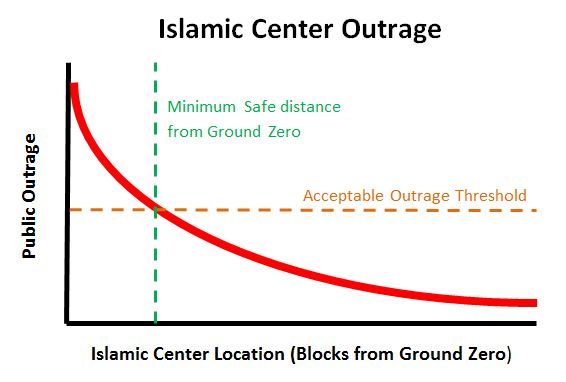
Islamic Center Outrage
I'm curious about how far an Islamic center needs to be from Ground Zero to be acceptable. 
Sphere: Related Content
Saturday, July 17, 2010
Subscribe to:
Posts (Atom)
