Saturday, April 20, 2013

Fun with the tax code

My favorite Daily Beaster, Megan McCardle, recently posted some pretty interesting observations on the tax code:
Anyway, I've got a better idea: let's get rid of the corporate income tax entirely. No, really, hear me out.  The corporate income tax is the source of almost all the tax-dodging activity in America.  This activity is extremely expensive, and millions of valuable man-hours are diverted into it.  As well as into writing semi-numerate op-eds about the corporate income tax. Why not get rid of the tax, and the tax avoidance, by radically simplifying the tax code?  Eliminate the corporate income tax--and then also eliminate the special rates for capital gains and dividends.  Tax all income once, progressively, when it's realized by a person.
This is a very attractive idea.  Any plan that drastically simplifies the tax code, saves untold billions in compliance costs, eliminates opportunities for tax evasion, and removes the motivation for employing half of K street, is worthy of serious consideration (even if the politics suck and the chances on enactment are approximately zero). In particular, it's interesting (to me anyway) to speculate on how enacting this reform might change individual and corporate behavior:
  • It would create a fairly powerful incentive for companies to retain earnings since this would allow shareholders to defer, though not ultimately avoid, taxation.  Dividends would probably become far less common.
  • Capital structure of firms would likely become more conservative (i.e. leverage would decrease) for two reasons:
    • Firms that retain their earnings have less need to borrow
    • Elimination of corporate taxes also eliminates the tax advantages of debt financing (corporate interest payments are tax deductible, which ceases to matter if the tax rate is zero)
  • Reductions in corporate dividends and issuance of corporate debt might have some interesting impacts on investment behavior.  Financial instruments like annuities may become more popular as investors look for ways to convert their portfolios into reliable income streams.
  • Personal loans with stock as collateral are likely to become much more popular, and may attract the attention of the IRS.
  • There would be a pretty dramatic adjustment period as firms scale back or abandon activities that were made economic by corporate tax breaks (bye-bye wind energy).
  • Since the denizens of K Street aren't going to go quietly, and politicians will remain found of doling out goodies to their favorite industries, we may see an expansion of subsidies, regulatory boondoggles, and unfunded mandates (welcome back wind energy).
  • The adjustment period may be very painful, but the long term payoff would be huge.  Eliminating the misallocation of resources for tax reasons, and the massive waste of time and energy associated with managing corporate tax issues, would probably add a few tenths of a percent to our long term growth rate.  Over time this would make the country much richer.
  • There is likely to be an expansion of audit activity at publically traded firms.  The loss of the tax cross check would likely cause greater scrutiny of corporate earnings, and there would be a lot of tax and finance people looking for new ways to justify their salaries.
  • There is likely to be a big movement of liquid assets that currently reside overseas back to Wall Street.  For tax reasons multinationals have a ton of cash in overseas accounts.  With no corporate tax there's no reason not to bring that money home.  This would help Wall Street, but hammer other financial centers.
  • On the down side, a great deal of tax driven financial engineering will suddenly become unnecessary.  Combine this with reduced issuance of corporate debt and Wall Street firms would probably take big hit (oh dear, so sad).
  • The impact on M&A activity is not totally easy to foresee.  On one hand firms are likely to accumulate cash and want to spend it on something.  On the other, any transaction creates a major taxable event for shareholders in the acquired firm.  On balance, I suspect firms may develop a bias for organic growth over acquisitions.
  • Cheating on your personal taxes would become much harder.  Eliminating corporate taxes would free up a ton of resources and greatly enhance incentives for the IRS to go after individual "evil-doers".  Anybody trying to run their personal expenses through a corporation would get crucified.
  • Tax collections are likely to be disappointing in the first few years as people take advantage of the opportunity to postpone taxes through opting for capital appreciation over income.  Tax revenue is likely to be higher than expected in the out years.  Eventually people want to spend, so they'll start cashing out and paying regular tax rates on their capital gains.  Combined with the aforementioned higher growth rate this would significantly improve the long term fiscal outlook.
    • If the switch happened tomorrow this would amount to a nice little bout of Keynesian stimulus, but not the kind of which Mr Krugman would approve.
  • If you think the politics of personal income taxes are brutal now, just wait until they become the vehicle for collecting taxes on all income.
    • Whatever business K Street loses from corporate clients is liable to be made up by new business lobbying congress on the individual tax code.
  • The change would have all kinds of international consequences:
    • Tax havens would likely lose a lot of corporate business, but see an increase in individual business.  The incentive for US taxpayers to push the envelope in order to minimize personal income taxes would increase dramatically.
    • In a major turnaround, the US may become a tax haven for foreign multi-nationals.
    • Since tax competition is not exactly popular in some major European capitals, a trade war with the EU wouldn't be out of the question.
    • Alternatively, the huge competitive advantage handed to US firms may force the same policy on foreign governments, which would set off a cascade of unpredictable consequences.  For example, the part of the Irish economy that didn't implode (European operations hub for US multi-nationals) exists largely because of Ireland's favorable corporate tax rate.  If corporate tax rates went to zero everywhere it could be farewell to the remaining remnants of the Celtic Tiger, and welcome back to the basket case exporter of music, whiskey and people.
Tragically, we are unlikely to find out if any of the above speculations are remotely close to the mark.  No matter how sound the economic arguments, there is no elected official, living or yet to be born, who is going to cast a vote for a zero tax rate on corporations.  The attack ads practically write themselves.

Sphere: Related Content

Wednesday, April 10, 2013

Disappointing job number

Last week we went through the monthly ritual of analyzing the jobs number and drawing sweeping economic and political conclusions from this single (provisional) data point. It seems like we could have more fun drawing sweeping economic and political conclusions from the extended data series.   Monthly growth of 200,000 jobs is widely considered to be indicative of a healthy recovery in the labor market (green line).  So far, the president's record doesn't look to healthy.
  • The US has added 200K jobs in just 14 of the president's 50 months in office
  • The longest stretch of 'healthy' job growth was 4 consecutive months (Dec-11 through Mar-12)
  • There have been 17 months of negative job growth
  • The 45 months since the official end of the recession (Jun-09) have included 12 months of negative job growth (i.e. one in four)
       

Sphere: Related Content

Thursday, July 19, 2012

President says something silly

The President has received a lot of Republican "feedback" on his statement that, "Somebody invested in roads and bridges. If you've got a business—you didn't build that." Leaving aside the astonishingly inept phrasing, the President's larger point is not unreasonable.  If you own a successful business you do benefit from things the government provide (rule of law, security, infrastructure, healthy educated workforce, basic research, etc).  It is really the logic that flows from this obvious truth that differentiates the President form his Republican critics. The President appears to believe that success flows from what the government provides.  Therefore the government is justified in taking the fruits of that success. Republicans tend to believe what the government is a necessary, but not sufficient, condition for individual success (even if they don't generally state it in this way).  Therefore the government has only a limited claim on the earnings of successful individuals. Beliefs about the relative importance of government have broader implications. The President's apparent belief that prosperity flows from government, implies that more government equals more prosperity.  From this viewpoint the cost of government is almost irrelevant. The Republican view that things provided by government are merely one of the preconditions for prosperity leads logically to the focus on providing these things at minimum cost. Unfortunately, we're unlikely to see much thoughtful debate about the relative merits of these two viewpoints.   Hammering the President for the dimwitted quote above is much more fun.

Sphere: Related Content

Sunday, June 24, 2012

How to become a billionaire

Interesting insight on how people become billionaires in different parts of the world. Many Americans appear to believe that they are the victims of a hopelessly corrupt economic system run by and for 1% oligarchs.  Before buying this narrative it might be a good idea to look at countries that actually have hopelessly corrupt economic system run by and for oligarchs.
Now look at Russia, where one hundred billionaires control fortunes worth an astonishing 20 percent of national GDP. Russia has nearly as many billionaires as China but they control twice as much total wealth in an economy one-fourth the size. Just as striking, Russia is missing not only a middle class but also a millionaire class; according to Boston Consulting Group, China ranks third in the world for number of millionaires, while Russia is not even in the top 15 for millionaires. The growing business influence of the state is reflected in the fact that 69 of those billionaires live in Moscow, the largest concentration for any city in the world. Protected by their patrons, the richest face little competition. Eight of the top 10 are holdovers from 2006. More than 80 percent of the wealth of Russian billionaires comes from non-productive industries like real estate, construction and especially commodities, namely oil and gas, in which political ties can sustain fortunes indefinitely. In no other developing nation is this share greater than 35 percent. Even in Brazil, a commodity economy at the same income level as Russia, the non-productive share of billionaires' wealth is just 12 percent.
 

Sphere: Related Content

Monday, April 25, 2011

Looking at the Money Supply

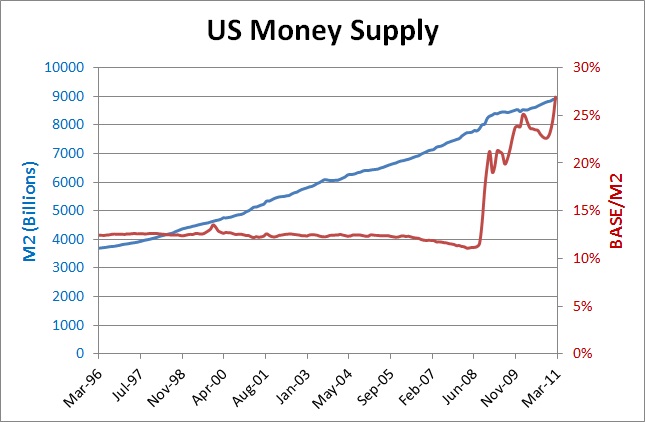
The following chart shows the growth in the broad money supply (M2) and BASE money supply as a percentage of M2 over the past 15 years.  BASE money supply is physical currency plus Federal Reserve accounts.  This is the portion of the overall money supply that the Fed directly controls. Data Source: St Louis Federal Reserve As you can see, M2 has been growing at a reasonably steady rate for the past 15 years.  BASE made up a reasonably constant proportion of M2 up until the end of 2008.  At that point the Fed had to dramatically increase the BASE money supply in order to keep M2 expanding at roughly the accustomed rate. There are a number of different ways of looking at this.  It could be that this is simply the new normal and the the Fed's balance sheet will henceforth make up a higher percentage of the overall money supply than has generally been the case. Alternatively, you could view the situation as essentially benign.  The Fed's balance sheet is relatively large because it had to respond to the crisis.  It will shrink over time as the economy recovers.  My guess is that this is Chairman Bernanke's preferred assessment. The pessimists among us tend to believe that quantitative easings are a bit like wars in the Middle East.  Much easier to get into than out of. I'm inclined towards pessimism.  There are very few free lunches in economics.  The Fed's extraordinary actions over the past few years may well have taken some of the bite out of the crisis, but my guess is that we pay for them through either inflation or uncomfortably tight monetary policy down the road.

Sphere: Related Content

Sunday, April 10, 2011

Unfortunately Serious

James Fallows of the Atlantic has given seven reasons that Paul Ryan's budget proposal is neither brave nor serious.   I'll grant that 6 out of 7 are pretty solid.  The exception is:
3) A plan that exempts from future Medicare cuts anyone born before 1957 -- about a quarter of the population, which includes me -- is neither brave nor serious. See "canny or cynical: take your pick" above.
This may not be brave, but is definitely serious. Old people are numerous and prone to voting.  They also have a choice.  If you are in your mid-fifties or older today there is a reasonable chance that you will be dead before the country's fiscal situation implodes.  It therefore makes sense to veto any proposal that reduces benefits. There are plenty of voters under the age of 54, but they are in a very different situation.  Barring untimely demise, these Americans will live to see the nations fiscal Waterloo.  They therefore have an incentive to accept painful reforms in order to avert the otherwise inevitable disaster. The political reality is that no reform that adversely impacts current AARP members has any chance of adoption.  It is neither brave nor serious to ignore that fact.

Sphere: Related Content

Sunday, January 16, 2011

Right Price?

I'm not sure exactly how they do it, but Goldman Sachs has an incredible ability to receive credit for being smarter than they probably are.  Consider this from the Wall Street Journal's Opinion page (gated):
In fact, the firm's real talent isn't knowing what the price will be, but what the price is. And Goldman clearly hit the mark with the $50 billion valuation implied by its $450 million investment in Facebook last week. The firm also rigged up a deal to make $1.5 billion in Facebook shares indirectly available to its well-heeled clients, and every sign is that the offer was oversubscribed.
If the offer was oversubscribed then Goldman clearly did not "hit the mark".  Having more willing buyers than shares to sell means the price was set to low and Goldman left money on the table - to the detriment of their clients, the existing shareholders of Facebook.

Sphere: Related Content