After France, which has the second largest welfare state? The USA!?!? http://pileusblog.wordpress.com/2014/01/28/the-united-states-big-welfare-state/
Tuesday, January 28, 2014


Sunday, November 17, 2013
Links to this, not entirely convincing, argument against negative income taxes have shown up in a couple of places lately (Tyler Cowen and Megan McArdle). There are several aspects of the post that are somewhat questionable. The one that I find most interesting is that we can achieve the same goals by simply recycling policy from the 90s.
Sphere: Related Content
"the only method that has consistently demonstrated in the U.S. that it can humanely get people off welfare and into jobs was the workfare movement of the 1990s (which it did without increasing government costs, by the way)."1990's reform was indeed fairly effective at reducing welfare dependency. However, context is important. In times of economic prosperity and relatively abundant job opportunities, limiting welfare eligibility can act as the spur that pushes people into active participation in the labor market. In tougher times it becomes somewhat questionable policy. In 2012 President Obama granted waivers to states allowing them breach limits specified in the legislation. Many Republicans were harshly critical of this move. However, the lousy economy meant there was no realistic way for states to meet the targets. Fundamentally, workfare operates on the assumption that employment opportunities are available if people are willing to take them. This need not always be the case. Employers are willing to take on an additional worker if a couple of things are true. Firstly, the value of the worker's output must exceed the cost of employment. Secondly, the cost of employment must be less than plausible alternatives, primarily outsourcing and automation. We live in a world where two things are inarguably true. The cost of employing people is going up. Obamacare is just the latest in a long line of policy initiatives which make employing people more expensive. Given the current Liberal enthusiasm for jacking up the minimum wage, it is almost certainly not going to be the last. Meanwhile, the cost of alternatives to employing people has collapsed. It is clichéd to point out that globalization and automation have reduced low skill employment. However, with regard to automation, we may be closer to the beginning than the end. Consider, for example, how many people with high school educations make a living driving. Then consider how close we are to a world in which most of those drivers won't be needed. This is not an argument that low skill employment must inevitably disappear. In a more economically rational world the price of low skill labor would fall to the point where employment opportunities would reappear – Say's Law to the rescue. But this is not an economically rationale world, it's a political one where the government mandates a floor price (minimum wage + payroll taxes + insurance + unemployment + ......) for low skill labor. In this world mandating that low skill people find work isn't going to achieve very much. They can't legally accept employment at a rate that sane employers would be willing to pay. Or, in other words, it isn't legal for low skill wages to fall to the market clearing rate. It's tempting to suggest that we should simply get rid of the minimum wage laws, payroll taxes, insurance requirements and regulations that drive up the cost of employing people. However, as politically viable policy this pretty much a non-starter. Even if Republicans had the House, the Whitehouse and a filibuster proof majority in the Senate can you imagine them repealing the minimum wage and replacing it with nothing? For political (and humanitarian) reasons, doing something about employment costs requires that we also have an alternative way of maintaining the total income of low skill people. Considered in this light, a well-designed Negative Income Tax solves two problems. It offers a better alternative to the horrendous existing tangle of welfare programs that supports people while preserving the incentive to work, which would be the usual argument made in its favor. In addition, it offers a possible solution to one of the more difficult policy challenges we face. How do you keep low skill people employed in a labor market which generates less and less demand for low skill labor at the current price?
Tuesday, November 12, 2013
Alan Blinder has put forward a defense of the Affordable Care Act in today's WSJ (gated). It's not terribly convincing. Considering some of his points:
Sphere: Related Content
"But a badly designed website doesn't signify a badly designed policy."True. But bad execution will kill a good idea just as effectively as a bad one. Also, the people who keep telling us that the ACA is good policy are the same ones who assured us that the website would be ready. Then that it would be fixed by December 1st, which now seems highly unlikely. credibility is becoming an issue.
"While Americans either read about or experience the website's failures firsthand, the enemies of health-care reform are telling them that ObamaCare is a failure. And since virtually no one actually understands how the new law works, the verdict sounds plausible."This is a pretty telling admission. The ACA passed 3 ½ years ago and we still don't know what's in it? What has the administration been doing all this time? Is a program that's too complicated to explain too complicated to execute? Was it even a good idea?
"Thus tech "glitches" make the law's critics look better and make the administration look like the gang that couldn't shoot straight." "It undermines trust in health-care reform and, more generally, in the government's ability to solve problems."Yup. Kind of a problem if your basic philosophy is that Washington needs to exercise more control over the economy.
"Regarding coverage, while the health-exchange website's problems are causing delays, they will be fixed—though I'm not sure I'd bet on Nov. 30. (If the administration makes that deadline, someone deserves a medal.) The initial enrollment period might have to be extended a bit, which would require some other adjustments. But even with delays, most of the uninsured will be able to get covered."I wouldn't bet on November 30th either. Nor December 30th for that matter. Mostly this seems like soft peddling a pretty big problem. If the initial enrolment period could easily be extended the Administration would have done it already. Unfortunately the calendar isn't infinitely flexible. Changes have consequences. From a perception perspective the situation is horrible. On Jan 1 more people will have lost private health insurance due to the ACA than gained it. A situation that may or may not be resolved by the end of open enrollment.
"Nor are the central elements of insurance reform affected by the technology glitches. Millions of people under the age of 26 are already benefiting by being kept on their parents' policies. Pre-existing conditions will no longer prevent people from getting health insurance. Annual and lifetime limits will go the way of the dodo. Americans will like all that."I'm sure they will, until they get the bill. All of these innovations will make health insurance more expensive. Free lunches are difficult to legislate.
"Regarding cost containment, some of the law's planned demonstration and pilot programs, designed to test various cost-reducing ideas, might be delayed. But they won't be abandoned. Delays will hurt a bit because these experiments were destined to take years to complete in any case, and our political system is not known for patience."Has there been any positive news whatsoever about any of these pilot programs? Negative news has been abundant.
"But there is at least some reason to think that the "affordable care" part of the act may be working already. The rate of inflation of medical costs has tumbled in recent years."We sacrificed the virgin, the volcano didn't erupt, therefore……..
"All that said, no big social policy ever goes exactly as planned. Two additional hazards that have garnered relatively little attention to date worry me. The first is the behavior of the "invincibles"—young people who, statistically speaking, are at little risk for high medical bills. To make universal coverage work, the government needs to bring them into the insurance pool as counterweights to the high-risk people."Not sure why we keep referring to young healthy people as "invincibles". Given what the legislation expects them to do "suckers" seems more appropriate.
"If many low-risk people stay out of the pool, we have a problem: The insured pool will be less healthy than the total population."Notice the subtle avoidance of the technical term for this possibility, which would be "death spiral". It's too early to know what young healthy people will choose to do. Many people place a very high value on having health insurance. Young people may choose sign up for this reason, to avoid 'wasting' money on the penalty, or simply because it's the law. Of course if the website can't be made to work they aren't getting on board and the ACA will become a case study in adverse selection.
"Second, there's the behavior of businesses with more than 50 employees. Some companies that now cover their workers with costly health-care plans might decide to drop that coverage once the exchanges are up and running."At this point businesses with lots of low wage employees resemble a group of penguins on the edge of the ice. Nobody wants to be the first to jump. But that doesn't mean they aren't considering taking the plunge. Best guess is that businesses with a lot of high turnover/low wage employees initially manage costs through restricting as many employees as possible to less than 30 hours per week. If the exchanges ever get unkinked, wholesale dumping of lower level employees onto the exchanges will begin shortly after.
"Considering all these problems, is the game worth the candle? Absolutely—because the status quo ante was so unacceptable. America cannot be a humane society if we leave 15% of our population uninsured."To be clear, even under the most optimistic assessments the ACA is going to solve maybe half of this problem – at enormous expense.
"America cannot be an efficient society if we spend 50% to 100% more of our incomes on health care than other countries, and yet don't get better health outcomes."The second part of this statement is dubious at best. Once you control for lifestyle differences (i.e. things like driving mileage, gun ownership etc.) that impact health but aren't healthcare related the US healthcare system stacks up pretty well. The first part is more interesting. Something like 17% of US GDP is healthcare. In other words 17% of the total economic output of the US is healthcare goods and services. That's a much higher percentage than other advanced countries, but is it the wrong percentage? Don't know, but then neither do any of the people who drafted the ACA.
"We can't let a botched website get in the way of goals that big."No. The poorly conceived, economically asinine, Rube Goldberg nature of the ACA is the reason we should start over. The botched website really is incidental.
Monday, November 11, 2013
Burger Automation
I've previously pointed out that hiking the minimum wage would likely prompt a wave of investment in automation. My guess is that it will take a while to work out the kinks. nevertheless, it would appear that highly automated fast food is closer to primetime than I thought. (hat tip: Marginal Revolution)
Sphere: Related Content
Wednesday, October 30, 2013
The Liar/Moron Dilemma
Greg Mankiw has posted a brief analysis of the President's repeated, and apparently false, assertion that, "If you like your plan, you can keep it."
Sphere: Related Content
1. The White House staff did not know the statement was false. That is, they did not understand the law the administration was promoting. 2. The White House staff knew the statement was false, but they decided to keep this fact from the President. That is, they let the President unwittingly lie to the American people. 3. The White House staff knew the statement was false and told the President so, but the President decided to keep saying it anyway. That is, the President consciously decided to lie to the American people.Options 1 and 2 are probably are a little problematic. Both imply that the President didn't really understand his own signature legislative achievement. Option 1 implies that not only did the President not know what he was doing but he employed people couldn't grasp a fairly obvious implication of the ACA. To simplify is the President a liar (Option 3) or a moron (Option 1 or 2)? It's difficult to know for sure, but the President would probably prefer liar. Perhaps somebody in the Whitehouse press corps should ask.
Friday, October 25, 2013
Assessing the Shutdown
Some time has passed. Passions have cooled. We can now make a level headed assessment of the shutdown strategy pursued by House Republicans. Objectively speaking it still sucked donkey d**k. Consider an alternate universe in which House Republicans passed a 'clean' CR, upped the debt ceiling for 6 months without conditions, then went on vacation for 2 weeks. In other words, did pretty much what Democrats asked them to do. In this universe the Republican Party has sustained zero reputational damage, the bungled Obamacare rollout has been the undisputed number one news story for a month, the President's approval ratings are in the toilet, Democratic unity is disintegrating as Democrats in vulnerable seats try desperately to distance themselves from Obamacare, and political world is decisively tipping in a Republican direction. Compare this to our world where the Republican brand has been thoroughly trashed, Democrats were gifted a talking point for the 2014 elections, divisions in the Republican party have been exacerbated, and the Whitehouse got a two week free pass from scrutiny over the rollout. In fairness, the Obamacare rollout may end up being such a catastrophe that it swamps memories of the budget shutdown. But it's very hard to see how Republicans are better off for having pursued the shutdown strategy. Our alternate universe looks much better for the Republican Party If the results of implementing your strategy were worse than the results of doing what your opponents asked you to do, then, inarguably, your strategy sucked.
Sphere: Related Content
Thursday, October 17, 2013
$15 Minimum Wage
There is currently a great deal of enthusiasm in Liberal circles for raising the minimum wage. In fact, a $15 minimum wage is on the ballot for upcoming elections in the Washington city of SeaTac and both Seattle mayoral candidates have expressed interest. To many this seems like an idea whose time has come. The optimistic case for a $15 minimum wage goes something like: Low wage workers spend a high percentage of their incomes, so increasing the minimum wage will increase demand which, along with lower turnover, higher productivity and higher employee satisfaction, will more than compensate employers for the increased wage cost, so there will be no impact on employment. In short, it's all sunshine and bunnies. There are several potential problems with this argument. However, if you want to dissuade a Liberal friend from voting for a $15 minimum wage it might be better to point out that even if the optimistic case turns out to be substantially true in the short term, raising the minimum wage makes low skill workers more expensive relative to possible substitutes, foreign labor and automation. Given time employers will find ways to utilize those substitutes. Consider your local McDonald's restaurant. Low wage workers take your order, fill it and clean up the mess you leave behind. McDonald's has experimented with automating all of these things to some degree. The reason your local McDonald's still employs a bunch of people is that they're currently cheaper and more flexible than the automation alternatives. Double the cost of employing those people and the cheaper part may no longer be true.
Sphere: Related Content
Friday, October 11, 2013
Something old....
This post referring to the savings glut has made me sentimental for Grad school. It was a problem back in 2006 too. In fact, it inspire the following SA (which was probably the most fun I've ever had doing homework):
Sphere: Related Content
Preface
Federal Reserve Chairman Ben Bernanke has suggested that a global saving glut is the primary cause of the unusual flattening of the treasury yield curve and is thus fueling the consumption boom that is driving the explosion of the US trade deficit[i]. Bernanke views the situation as relatively benign and expects it to unwind gradually over time. Other commentators are less sanguine and have suggested a variety of remedies. Most discussion seems to revolve around how to induce higher consumption and lower savings rates in Asia. Reducing savings rates is certainly one way to address the excess savings problem. However it is not the only possibility. We can invert the issue and suggest that the problem isn't so much an excess of savings as a shortage of investment opportunities. So the question becomes what could we do to put all those surplus savings to use? One suggestion: Colonize the moon.Why the moon?
At first glance the moon does not look like a particularly attractive destination. However it is important to remember that in 1607 (founding date of Jamestown, VA) what is now the US was a tractless wasteland inhabited by hostile natives and separated from civilization by a long and dangerous sea voyage. In order to understand why the moon might be attractive it is helpful to consider what the moon lacks:Now consider what the moon does have; 58.6 million square miles of unclaimed and never mined real estate conveniently located just 385,000km away. The moon also has the twin benefits of low gravity and negligible atmosphere. It may not be immediately obvious why the second point is important. Low gravity and no discernable atmosphere mean that it requires relatively little energy to launch objects from the lunar surface. Thus the products of lunar industry would thus be relatively easy to export. Simply sling them into space and let earth's much stronger gravity pull them back into earth orbit where they can be collected for return to the surface. In addition, there are the obvious tourism opportunities. The moon offers spectacular scenery, numerous historic sites, and plus entertainingly low gravity. As the ultimate vacation destination the moon would have little in the way of competition.
- Pollutable atmosphere, waterways or oceans
- Conservable wildlife of any kind
- Disenfranchised natives
- Regulations
- Activists
What might it cost?
It is somewhat difficult to estimate what kind of investment lunar colonization might require. As a starting point we can consider how much cost to visit the moon in the 1960's and 70's. The total cost of Apollo and associated programs was approximately $135 billion in 2006 dollars[ii]. While establishing a human presence on the moon is a much bigger objective than simply visiting the moon it is important to remember two important facts. Firstly, the Apollo program was administered by NASA which is hardly famous for cost minimization. Secondly, NASA started at the very bottom of the space learning curve. Any lunar colonization effort will have the benefit of a lot of expensively acquired experience. For these reasons it seems reasonable, in the absence of other data, to suggest that $135 billion is probably a reasonable ballpark cost estimate for a commercial effort to establish a human presence on the moon.Structuring the venture
It might be somewhat difficult to raise $135 billion for a moon colonization venture. For arguments sake let us stipulate that it might be possible to raise $3 billion from risk hungry investors. Private equity and hedge funds routinely exceed this size, so $3 billion isn't inconceivable provided there is a good investment story to tell. In order to actually build a lunar colony it would be necessary to invest the $3 billion such that it provokes considerably more investment. The key is to identify all the components required to make colonization possible and then seed ventures to develop each of those components. These could be start-ups or joint ventures with established companies. For example, our lunar colonization investment fund might approach Boeing to develop a next generation launch system. Boeing provides the engineering capability while our company provides the first billion in funds. Once this is spent Boeing can either find risk sharing partners and develop the project to completion, in the same way it does for new aircraft, or take a pass. From Boeing's perspective this would look like a paid R&D project with a free option to create a new product line if it looks commercially attractive. Essentially we would be creating a portfolio of ventures each of which is valuable because of the existence of the others. The fact that a complete lunar colonization solution is being developed will make each of the components viable investment prospects and allow each of the component ventures to raise funds individually. The return to the original investors comes from the eventual liquefaction of the fund's equity stakes in the component ventures. Notice that this investment strategy is the exact opposite of diversification. For this reason the investors really would need a significant appetite for risk. However the upside of owning a piece of every major project supplying the commercialization of the moon is potentially huge. Creating the necessary equipment is just the first half of the equation. The next step is to create a customer to buy it. Essentially we need to create an airline with a truly unique route network. This would undoubtedly be very expensive. However, raising the required funds need not be especially difficult if demand for transport to and from the moon could be demonstrated. By the time it is necessary to launch our lunar airline it is entirely possible that demand will have already materialized. After all Virgin Galactic is currently busy collecting $20,000 deposits for sub-orbital tourist space flights it does not plan to undertake until 2008. While lunar tourism is certainly one potential source of revenue, the potential of a lunar airline is much greater. The opening of a dependable link to the moon will inevitably lead to colonization and commercial exploitation. That means ferrying not just people, but cargo – equipment and supplies – to and from the moon.Creating Property Rights
A necessary precondition for inducing people to invest in moon based commercial ventures will be the creation of property rights. Upon landing on the moon in 1969 Neil Armstrong claimed it for, "all mankind", which essentially means the moon isn't currently owned by anybody in particular. There is a UN sponsored treaty governing ownership of celestial bodies however it has been signed by very few countries and ratified by even fewer. The US is not a signatory. This would seem to leave the establishment of lunar property rights wide open. Initially it might seem tempting to claim ownership based on the establishment of a lunar presence and then and sell lunar property. This is not a great idea for several reasons. Firstly, it is difficult to sell something for which the legal basis for ownership is ambiguous. Secondly, any attempt to claim ownership is likely to provoke a government response either in the form of legislation or competing lunar programs. Finally, putting a price on lunar property acts as a disincentive for the lunar investment required to make the whole venture worthwhile. From a historical perspective, it should be noted that what really got the colonization of the US underway was the promise of free land. A better approach would be to create a registry for claiming lunar property. The idea would be to divide the moon up into parcels which anybody who was interested would be free to make a claim. The trick is that claims office would be located on the moon. So lunar property would be available to anyone, or any corporation, committed enough to lunar ownership that they are prepared to travel there, or at least send a representative. Two key details would be required to make the system workable. Firstly there would need to be a limit of one land parcel per claimant to prevent the first arrival claiming the whole moon. The restriction would apply purely to claims, lunar property holders would be able to add to there holdings by purchasing property from each other. Secondly, a condition of making a claim would be acceptance that disputes would be resolved in the courts of some suitable jurisdiction, for example Delaware. Notice that this not only creates a system of land rights that is sufficiently fair and open that influential governments are unlikely to feel the need to intervene, it also creates an incentive for people to visit the moon as soon as the system is in place.Conclusion
By developing the necessary equipment, creating a transport link and building an acceptable system of property rights it may possible for us to open the final frontier. In doing, so we will open an entirely new frontier for investment and have created a really interesting, and potentially rewarding, use for world's surplus savings.
[i] Speech April 14 2005 – "The Global Saving Glut and the U.S. Current Account Deficit"[ii] Marcus Lindroos - http://www.asi.org/adb/m/02/07/apollo-cost.html - estimate adjusted from 1994 to 2006 dollars
Wednesday, September 18, 2013
Paul Krugman, as he's rather fond of doing, has been pointing out that predictions that loose monetary policy would spark inflation have so far proved embarrassingly inaccurate.
Sphere: Related Content
"Republicans predicted poor economic performance under Obama. And to be fair, the economy has not done particularly well. The crucial point, however, is the nature of the poor performance. Republicans confidently predicted Weimar 2.0 — soaring interest rates and inflation. They lambasted not just Obama but Bernanke — in fact, their attacks on Fed policy had more passion than their attacks on the stimulus, which after all didn't last long."An interesting question to consider is why predictions of high inflation, which many conservative pundits made, have been so wrong. Perhaps the simplest answer is that they assumed loose monetary policy would work. To date the results have been unimpressive. Inflation has remained quiescent in large part because cheap money hasn't resulted in dramatic increases in lending and consumption. This leads to the somewhat ironic situation that the advocates of tighter monetary policy overestimated the threat of inflation in large part because the advocates of looser monetary policy overestimated the economic benefits of that policy.
Sunday, September 8, 2013
Unexpectedly
Congress spent the past week having a serious, thoughtful, substantive and bipartisan debate about Syria. On the down side this does highlight an uncomfortable truth. The partisan dysfunction we normally expect from Washington isn't due to the failings of our elected representatives, however much we might enjoy blaming them. When circumstances require it, Congress is clearly capable of operating in the way we say we'd prefer. The fact that serious, thoughtful, substantive and bipartisan debate is largely absent from every other issue simply reflects the deep political divisions in the country as a whole. Red and blue voters demand that their representatives hold to strict party lines. So they do.
Sphere: Related Content
Saturday, April 20, 2013
Fun with the tax code
My favorite Daily Beaster, Megan McCardle, recently posted some pretty interesting observations on the tax code:
Sphere: Related Content
Anyway, I've got a better idea: let's get rid of the corporate income tax entirely. No, really, hear me out. The corporate income tax is the source of almost all the tax-dodging activity in America. This activity is extremely expensive, and millions of valuable man-hours are diverted into it. As well as into writing semi-numerate op-eds about the corporate income tax. Why not get rid of the tax, and the tax avoidance, by radically simplifying the tax code? Eliminate the corporate income tax--and then also eliminate the special rates for capital gains and dividends. Tax all income once, progressively, when it's realized by a person.This is a very attractive idea. Any plan that drastically simplifies the tax code, saves untold billions in compliance costs, eliminates opportunities for tax evasion, and removes the motivation for employing half of K street, is worthy of serious consideration (even if the politics suck and the chances on enactment are approximately zero). In particular, it's interesting (to me anyway) to speculate on how enacting this reform might change individual and corporate behavior:
- It would create a fairly powerful incentive for companies to retain earnings since this would allow shareholders to defer, though not ultimately avoid, taxation. Dividends would probably become far less common.
- Capital structure of firms would likely become more conservative (i.e. leverage would decrease) for two reasons:
- Firms that retain their earnings have less need to borrow
- Elimination of corporate taxes also eliminates the tax advantages of debt financing (corporate interest payments are tax deductible, which ceases to matter if the tax rate is zero)
- Reductions in corporate dividends and issuance of corporate debt might have some interesting impacts on investment behavior. Financial instruments like annuities may become more popular as investors look for ways to convert their portfolios into reliable income streams.
- Personal loans with stock as collateral are likely to become much more popular, and may attract the attention of the IRS.
- There would be a pretty dramatic adjustment period as firms scale back or abandon activities that were made economic by corporate tax breaks (bye-bye wind energy).
- Since the denizens of K Street aren't going to go quietly, and politicians will remain found of doling out goodies to their favorite industries, we may see an expansion of subsidies, regulatory boondoggles, and unfunded mandates (welcome back wind energy).
- The adjustment period may be very painful, but the long term payoff would be huge. Eliminating the misallocation of resources for tax reasons, and the massive waste of time and energy associated with managing corporate tax issues, would probably add a few tenths of a percent to our long term growth rate. Over time this would make the country much richer.
- There is likely to be an expansion of audit activity at publically traded firms. The loss of the tax cross check would likely cause greater scrutiny of corporate earnings, and there would be a lot of tax and finance people looking for new ways to justify their salaries.
- There is likely to be a big movement of liquid assets that currently reside overseas back to Wall Street. For tax reasons multinationals have a ton of cash in overseas accounts. With no corporate tax there's no reason not to bring that money home. This would help Wall Street, but hammer other financial centers.
- On the down side, a great deal of tax driven financial engineering will suddenly become unnecessary. Combine this with reduced issuance of corporate debt and Wall Street firms would probably take big hit (oh dear, so sad).
- The impact on M&A activity is not totally easy to foresee. On one hand firms are likely to accumulate cash and want to spend it on something. On the other, any transaction creates a major taxable event for shareholders in the acquired firm. On balance, I suspect firms may develop a bias for organic growth over acquisitions.
- Cheating on your personal taxes would become much harder. Eliminating corporate taxes would free up a ton of resources and greatly enhance incentives for the IRS to go after individual "evil-doers". Anybody trying to run their personal expenses through a corporation would get crucified.
- Tax collections are likely to be disappointing in the first few years as people take advantage of the opportunity to postpone taxes through opting for capital appreciation over income. Tax revenue is likely to be higher than expected in the out years. Eventually people want to spend, so they'll start cashing out and paying regular tax rates on their capital gains. Combined with the aforementioned higher growth rate this would significantly improve the long term fiscal outlook.
- If the switch happened tomorrow this would amount to a nice little bout of Keynesian stimulus, but not the kind of which Mr Krugman would approve.
- If you think the politics of personal income taxes are brutal now, just wait until they become the vehicle for collecting taxes on all income.
- Whatever business K Street loses from corporate clients is liable to be made up by new business lobbying congress on the individual tax code.
- The change would have all kinds of international consequences:
- Tax havens would likely lose a lot of corporate business, but see an increase in individual business. The incentive for US taxpayers to push the envelope in order to minimize personal income taxes would increase dramatically.
- In a major turnaround, the US may become a tax haven for foreign multi-nationals.
- Since tax competition is not exactly popular in some major European capitals, a trade war with the EU wouldn't be out of the question.
- Alternatively, the huge competitive advantage handed to US firms may force the same policy on foreign governments, which would set off a cascade of unpredictable consequences. For example, the part of the Irish economy that didn't implode (European operations hub for US multi-nationals) exists largely because of Ireland's favorable corporate tax rate. If corporate tax rates went to zero everywhere it could be farewell to the remaining remnants of the Celtic Tiger, and welcome back to the basket case exporter of music, whiskey and people.
Wednesday, April 10, 2013
Disappointing job number
Last week we went through the monthly ritual of analyzing the jobs number and drawing sweeping economic and political conclusions from this single (provisional) data point. It seems like we could have more fun drawing sweeping economic and political conclusions from the extended data series. Monthly growth of 200,000 jobs is widely considered to be indicative of a healthy recovery in the labor market (green line). So far, the president's record doesn't look to healthy.
Sphere: Related Content
- The US has added 200K jobs in just 14 of the president's 50 months in office
- The longest stretch of 'healthy' job growth was 4 consecutive months (Dec-11 through Mar-12)
- There have been 17 months of negative job growth
- The 45 months since the official end of the recession (Jun-09) have included 12 months of negative job growth (i.e. one in four)
Thursday, July 19, 2012
President says something silly
The President has received a lot of Republican "feedback" on his statement that, "Somebody invested in roads and bridges. If you've got a business—you didn't build that." Leaving aside the astonishingly inept phrasing, the President's larger point is not unreasonable. If you own a successful business you do benefit from things the government provide (rule of law, security, infrastructure, healthy educated workforce, basic research, etc). It is really the logic that flows from this obvious truth that differentiates the President form his Republican critics. The President appears to believe that success flows from what the government provides. Therefore the government is justified in taking the fruits of that success. Republicans tend to believe what the government is a necessary, but not sufficient, condition for individual success (even if they don't generally state it in this way). Therefore the government has only a limited claim on the earnings of successful individuals. Beliefs about the relative importance of government have broader implications. The President's apparent belief that prosperity flows from government, implies that more government equals more prosperity. From this viewpoint the cost of government is almost irrelevant. The Republican view that things provided by government are merely one of the preconditions for prosperity leads logically to the focus on providing these things at minimum cost. Unfortunately, we're unlikely to see much thoughtful debate about the relative merits of these two viewpoints. Hammering the President for the dimwitted quote above is much more fun.
Sphere: Related Content
Sunday, June 24, 2012
How to become a billionaire
Interesting insight on how people become billionaires in different parts of the world. Many Americans appear to believe that they are the victims of a hopelessly corrupt economic system run by and for 1% oligarchs. Before buying this narrative it might be a good idea to look at countries that actually have hopelessly corrupt economic system run by and for oligarchs.
Sphere: Related Content
Now look at Russia, where one hundred billionaires control fortunes worth an astonishing 20 percent of national GDP. Russia has nearly as many billionaires as China but they control twice as much total wealth in an economy one-fourth the size. Just as striking, Russia is missing not only a middle class but also a millionaire class; according to Boston Consulting Group, China ranks third in the world for number of millionaires, while Russia is not even in the top 15 for millionaires. The growing business influence of the state is reflected in the fact that 69 of those billionaires live in Moscow, the largest concentration for any city in the world. Protected by their patrons, the richest face little competition. Eight of the top 10 are holdovers from 2006. More than 80 percent of the wealth of Russian billionaires comes from non-productive industries like real estate, construction and especially commodities, namely oil and gas, in which political ties can sustain fortunes indefinitely. In no other developing nation is this share greater than 35 percent. Even in Brazil, a commodity economy at the same income level as Russia, the non-productive share of billionaires' wealth is just 12 percent.
Monday, April 25, 2011
Looking at the Money Supply
The following chart shows the growth in the broad money supply (M2) and BASE money supply as a percentage of M2 over the past 15 years. BASE money supply is physical currency plus Federal Reserve accounts. This is the portion of the overall money supply that the Fed directly controls.  As you can see, M2 has been growing at a reasonably steady rate for the past 15 years. BASE made up a reasonably constant proportion of M2 up until the end of 2008. At that point the Fed had to dramatically increase the BASE money supply in order to keep M2 expanding at roughly the accustomed rate. There are a number of different ways of looking at this. It could be that this is simply the new normal and the the Fed's balance sheet will henceforth make up a higher percentage of the overall money supply than has generally been the case. Alternatively, you could view the situation as essentially benign. The Fed's balance sheet is relatively large because it had to respond to the crisis. It will shrink over time as the economy recovers. My guess is that this is Chairman Bernanke's preferred assessment. The pessimists among us tend to believe that quantitative easings are a bit like wars in the Middle East. Much easier to get into than out of. I'm inclined towards pessimism. There are very few free lunches in economics. The Fed's extraordinary actions over the past few years may well have taken some of the bite out of the crisis, but my guess is that we pay for them through either inflation or uncomfortably tight monetary policy down the road.
Sphere: Related Content
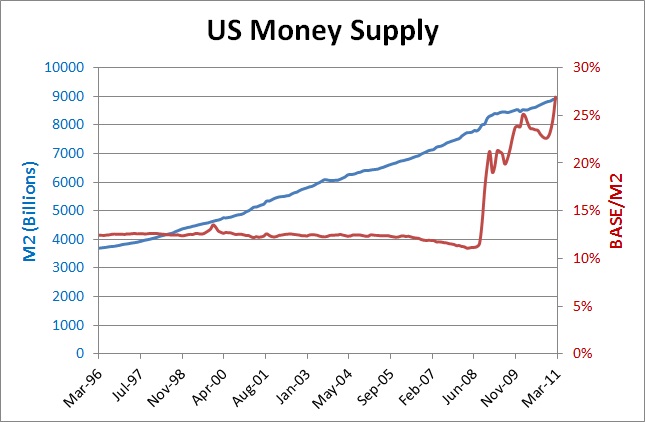 As you can see, M2 has been growing at a reasonably steady rate for the past 15 years. BASE made up a reasonably constant proportion of M2 up until the end of 2008. At that point the Fed had to dramatically increase the BASE money supply in order to keep M2 expanding at roughly the accustomed rate. There are a number of different ways of looking at this. It could be that this is simply the new normal and the the Fed's balance sheet will henceforth make up a higher percentage of the overall money supply than has generally been the case. Alternatively, you could view the situation as essentially benign. The Fed's balance sheet is relatively large because it had to respond to the crisis. It will shrink over time as the economy recovers. My guess is that this is Chairman Bernanke's preferred assessment. The pessimists among us tend to believe that quantitative easings are a bit like wars in the Middle East. Much easier to get into than out of. I'm inclined towards pessimism. There are very few free lunches in economics. The Fed's extraordinary actions over the past few years may well have taken some of the bite out of the crisis, but my guess is that we pay for them through either inflation or uncomfortably tight monetary policy down the road.
 Sunday, April 10, 2011
Unfortunately Serious
James Fallows of the Atlantic has given seven reasons that Paul Ryan's budget proposal is neither brave nor serious. I'll grant that 6 out of 7 are pretty solid. The exception is:
Sphere: Related Content
3) A plan that exempts from future Medicare cuts anyone born before 1957 -- about a quarter of the population, which includes me -- is neither brave nor serious. See "canny or cynical: take your pick" above.This may not be brave, but is definitely serious. Old people are numerous and prone to voting. They also have a choice. If you are in your mid-fifties or older today there is a reasonable chance that you will be dead before the country's fiscal situation implodes. It therefore makes sense to veto any proposal that reduces benefits. There are plenty of voters under the age of 54, but they are in a very different situation. Barring untimely demise, these Americans will live to see the nations fiscal Waterloo. They therefore have an incentive to accept painful reforms in order to avert the otherwise inevitable disaster. The political reality is that no reform that adversely impacts current AARP members has any chance of adoption. It is neither brave nor serious to ignore that fact.
Sunday, January 16, 2011
Right Price?
I'm not sure exactly how they do it, but Goldman Sachs has an incredible ability to receive credit for being smarter than they probably are. Consider this from the Wall Street Journal's Opinion page (gated):
Sphere: Related Content
In fact, the firm's real talent isn't knowing what the price will be, but what the price is. And Goldman clearly hit the mark with the $50 billion valuation implied by its $450 million investment in Facebook last week. The firm also rigged up a deal to make $1.5 billion in Facebook shares indirectly available to its well-heeled clients, and every sign is that the offer was oversubscribed.If the offer was oversubscribed then Goldman clearly did not "hit the mark". Having more willing buyers than shares to sell means the price was set to low and Goldman left money on the table - to the detriment of their clients, the existing shareholders of Facebook.
Thursday, December 9, 2010
How can supposedly professional politicians be so shockingly bad at politics?
House Democrats have decided to make a great show of refusing to support the President's deal on extending the Bush tax cuts. It is difficult to understand why any remotely competent politician would take on such a clearly untenable position. The inevitable climb down is clearly going to be deeply humiliating. At the present time Democrats currently have two plausible alternatives:
Sphere: Related Content
- Pass, however grudgingly, the President's tax deal
- Dig their heals in and ensure that:
- The President is severely damaged (What use is a President who can't even rally his own party?)
- Democrats take the blame for everyone's taxes going (Can't avoid that when you willfully torpedo a bipartisan deal)
- The replacement deal to extend the Bush tax cuts will be done by the next Congress, in which Democrats will have even less leverage (Because that's what happens when you lose the house)
Sunday, December 5, 2010
Tuesday, November 30, 2010
A Dose of Reality for Fiscal Conservatives
It appears that Messers. Erskine and Bowles are having some difficulty rounding up support from either Republicans or Democrats for their deficit reduction proposal. This was entirely predictable, but very disheartening for those of us who would like to see the deficit reduced mainly through expenditure control. What Republicans have apparently failed to grasp is that time is not on the side of fiscal conservatives. As this insightful article points out, the longer we wait the more inevitable tax increases become:
Sphere: Related Content
To understand the stakes facing fiscal conservatives, one must appreciate how demographics, program indexing methods and political realities combine to stack the deck against them. By bipartisan consensus, we won't cut the benefits of those already in retirement; we won't send a $2000 check to an 85-year-old widow in January and then cut it back to $1600 in February. Both parties (including the most conservative members) repeatedly reaffirm their dedication to this principle. As a result, with each new class of retirees there is a new set of politically inviolate benefit obligations. Moreover, due to the wage-indexation of the initial benefit formula, the minimum threshold of politically acceptable future benefits rises with each subsequent class of retirees. So, with each year of delay the share of the problem eventually solved by tax increases inevitably rises.* Well before 2037, unless we cut benefits for those already retired, a tax increase could not be avoided even if the entirety of payments to new beneficiaries were shut off. Thus, if action is delayed for several years, virtually all of the "solution" will consist of tax increases. Our potential success in constraining the growth of taxpayer burdens therefore depends largely on when a solution is enacted. It is not so simple as deciding a particular solution is faulty, tearing it up, and trying again in a few years on the hope that conservatives' political position will then be stronger. Such a strategy naively ignores demographic realities. Enacting Simpson-Bowles by contrast would allow conservatives to lock in constraints upon cost growth that simply will not be achievable under a delayed solution.Republicans may not actually be serious about deficit reduction. Or they may be calculating that they will be able to negotiate a better deal next year. If the latter is true they are making a serious gamble. The election largely wiped out Democratic moderates. The Democrats who remain are likely to be more committed to closing the fiscal gap with new taxes, and very much aware that they only need to stall in order to get their way. The Republicans have the opportunity right now to shape the deficit debate by endorsing some variant of the 'bi-partisan' Erskine-Bowles plan. If they instead try and push a Republican plan next year the chances of getting a deal drop to near zero. Unfortunately for the country, failure to get a deal is effectively the same as voting for higher taxes. * Reference to a chart showing projected increase in Social Security beneficiaries has been omitted from the quote
Subscribe to:
Posts (Atom)
